Showing posts with label South Dakota. Show all posts

Saturday, September 5, 2009

South Dakota – Campground and Birds

IMG_5814

Our site at Rafter J RV Park

While visiting all of the great sites around Mt. Rushmore we stayed at Rafter J RV Park. This RV Park has 200 sites spread over 160 acres. We have never had a site as large as the one you see in the picture above. It was also very quiet and had free WIFI.

Another thing that Rafter J had was BIRDS! Just sitting at our campsite we would see both adult and juvenal Mountain Blue Bird catching grasshoppers. Flocks of Barn Swallows, Chipping Sparrows and the White Winged sub-race of the Slate-gray race of Dark-eyed Juncos.

IMG_5789

IMG_5792-Immature Mtn Blue Bird

 P1010693

  P1010680


P1010674P1010676 IMG_5784-Chipping SparrowP1010683

Friday, September 4, 2009

South Dakota’s Hidden Treasures – Part 2 Jewel Cave National Monument

P1010798

Jewel Cave formations

Jewel Cave was designated a National Monument in 1908 to protect what was then thought to be a small but beautiful cave. Today cavers have mapped over 140 miles of passages making Jewel Cave the second biggest cave in the world. Using the volume of air that comes out of the cave scientist estimate that Jewel Cave has over 3,000 miles of undiscovered and so far uncharted passages. Yes, over 3,000 miles! Today it takes the survey team 10 hours to travel from the elevator that takes them into cave to the last position mapped.

P1010817 P1010814

P1010785

The above three pictures show some of the Calcite Crystals which the cave was named after.

Jewel Cave is a much wetter cave than Wind Cave; it has miles of twisting passages and some of the formations that one would expect to  see in a “wet” cave.

P1010820

Cave bacon

P1010791 P1010792 P1010806-1

Examples of flowstone

P1010795

In the center of this pictures is a long hollow “soda straw” formation. It took millions of years to get that long.

P1010826 

Beginning the long walk back to the elevators. This tour had over 760 stair steps!

P1010823

Again frustratingly, of the over 140 mapped miles of the cave only about 1 mile is opened to the public.

Many more pictures of Jewel Cave on the slideshow:

South Dakota’s Hidden Treasures – Part 1 Wind Cave National Park

P1010763

South Dakota’s Hidden Treasures are truly hidden underground. They are Wind Cave National Park and Jewel Cave National Monument. As I wrote before “Everyone comes to the Black Hills to see Mt. Rushmore or maybe the Crazy Horse Memorial. No one comes to or even knows about Custer State Park until they arrive in the Black Hills.” Even less people seem to know about Wind Cave National Park and Jewel Cave National Monument. Each of which precedes both Mt. Rushmore and Crazy Horse by decades.


P1010746

Wind Cave National Park was established in 1903 as the 7th National Park and the first protected cave. Cavers have meticulously mapped over 130 MILES of tunnels at Wind Cave making it the 4th largest cave in the world. Even more amazing is, according to the measured air volume coming out of the cave, scientists believe that the tunnels in  Wind Cave exceed 2,000 miles!!! YES, 2,000 miles!

P1010757

“Boxwork” in Wind Cave National Park,

Unlike most caves Wind Cave was not formed by running water. It was formed by water trapped in the limestone for millions of years that ate away at the limestone and moved through any cracks or fishers in the stone. Among the reasons why they are sure of this is that Wind Cave has no stalactites, stalagmites or other formations that are in caves that were formed “wet”. Another reason is the existence of boxwork. This formation is about as delicate as a potato chip. Any running water in the cave would have destroyed the boxwork formation which is plentiful in the cave. Apparently boxwork is formed as stagnant pools of water eat away at the limestone.

P1010716

More boxwork in Wind Cave

Because of the way Wind Cave was formed it is a surprising compact cave. The entire 136 miles of mapped passages only cover 1 square mile on the surface. Wind Cave passages are a maze of interconnecting mostly long narrow passages that are in three levels going down to just over 500 feet deep.

P1010721    P1010755

I think that Wind Cave is the best cave we have ever been with the exception of Carlsbad Caverns. We liked so much we went back a second day to do another tour. Our first tour started with an elevator ride down to 220 feet and then there are 450 steps to the tour. The second tour we did started at the surface near the cave’s natural entrance and walks down 300 steps to the elevator.

P1010847

This is the natural entrance to Wind Cave. The wind is so strong coming out of the cave that the first  white people to find it had their hat blown off of their head and supported by the wind. The opening at its narrowest is only about 8 inch across. The “discoverers” of Wind Cave got dynamite and blew a hole next to the natural opening. Today the Park Service has installed a door where the dynamite had been.

P1010850

Our second tour began with a long steep staircase descent.

P1010872

More stairs

P1010864P1010886

More boxwork formations

P1010873 

P1010859

Frustratingly, only about 2 miles of the mapped 130 miles of the cave is opened to the public.

There are plenty more pictures of Wind Cave National Park on the slideshow:

Thursday, August 27, 2009

Custer State Park - South Dakota’s “Best Kept Secret!”

Yearling Pronghorns

Custer State Park must be South Dakota’s “Best Kept Secret”! Everyone comes to the Black Hills to see Mt. Rushmore or maybe the Crazy Horse Memorial. No one comes to or even knows about Custer State Park until they arrive in the Black Hills. As their Web Site says “Custer State Park in the Black Hills encompasses 71,000 acres of spectacular terrain and an abundance of wildlife. Within the park, you’ll discover a world of adventure!” Custer" State Park is just south of Mt. Rushmore. Think of it as Yellowstone without the geysers.

Think of it as Yellowstone without the geysers, they have wildlife:

They have herds of buffalo! We saw them everywhere we drove in the park.

They have BIG buffalo

They have little buffalo

They have buffalo jams! There are over 1,500 free roaming buffalo in Custer State Park.

They have Big Horn Sheep

This herd of female Big Horn Sheep was grazing in a picnic area right next to the road.

They have Pronghorn Antelope! We saw them in several locations in the park.

They have Prairie Dogs. We saw several large Prairie Dog towns.

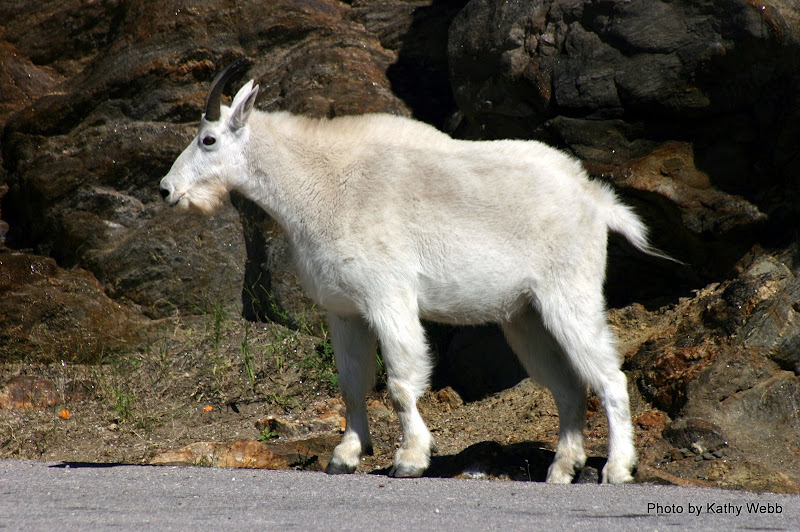
They have Mountain Goats! What are Mountain Goats doing at these low altitudes? They started from six goats. given as a gift from Canada back in the 1924 that escaped from their pen. One source we saw said there are now thought to be 400 Mountain Goats between Custer State Park  and Mt. Rushmore. So, if you go to Mt. Rushmore at exactly the right time you could see a Mountain Goat standing on George Washington's head.

They have wild burros! These are from escaped burros used for tourists back in the 1920s. We also saw a White-tailed Deer, but couldn’t get a picture.

To add even more interest to the area back in the 1930’s they built tunnels that frame the faces on Mt. Rushmore and then built the roads so that they would line up with the tunnels. To accomplish this they have roads the loop under themselves.

The faces on Mt. Rushmore are over exposed in this picture, but you get the idea.

This is the view from the other side of the tunnel.

These are very narrow one lane tunnels. There is a tunnel in the Needles area of the park that is so narrow that there would only be one inch of clearance on each side of our truck. Needless to say we didn’t travel that road.

Sunday, August 23, 2009

South Dakota – Crazy Horse Memorial

About 8 miles south of Mt. Rushmore is the Crazy Horse Memorial. The two projects couldn’t be more different. Back in the 1920’s as the discussion and work on Mt. Rushmore began, the Lakota Indians (then know as the Sioux Indians) were outraged that their scared Black Hills would be defaced. In the non-politically correct days of the 1920’s, no one really cared what the Indians thought. In 1939, Chief Henry Standing Bear of the Lakota, wrote Korczak Ziółkowski, a well  known sculptor that was working with Gutzon Borglum at Mt. Rushmore. He said, "My fellow chiefs and I would like the white man to know the red man has great heroes, too.” He was proposing a monument to honor all Native Americans.

Ziolkowski started working on plans for the sculpture, however, work stopped during World War II, while Ziółkowski was in the Army. In 1947 Korczak Ziółkowski returned to the Black  Hills to take up the Crazy Horse sculpture. The Lakota Elders wanted the memorial in the sacred Black Hills.

Mt. Rushmore was federally funded from the very beginning, when in 1925 Congress authorized the Mount Rushmore National Memorial Commission. The Crazy Horse Memorial accepts no government money, they have even turned down millions of dollars in Federal Funding.

When Gutzon Borglum began work on Mt. Rushmore he had 100’s of workers. In 1947 when Korczak Ziółkowski began working on the Crazy Horse Memorial, he worked alone. Work continued slowly as donations of money and equipment would permit. As Korczak Ziółkowski worked on the memorial, his wife, Ruth, took care of their children and the tourists coming to see the project. As the 10 children grew, they were added to the work crew. Korczak Ziółkowski continued to work on the Crazy Horse Memorial until his death in 1982. At that time his wife and 7 of his 10 children took over and still run the project today. They continue to fund the project from donations and entrance fees to see the work completed some day. Currently they receive over a million visitors a year.

The model of the finished sculpture

The picture with work superimposed on to the mountain.

The monument is to be the largest sculpture in the world. If it is completed, it will be 563 feet high, by 641 feet long. Crazy Horse’s head will be large enough to contain all of the 60 foot high heads of the Presidents at Mt. Rushmore. Since they have  been working on it for 62 years and have only completed the head of Crazy Horse I don’t like my chances of seeing it completed.

In 1939, Ziółkowski's marble sculpture of Ignacy Jan Paderewski won first prize at the New York World's Fair.


Bronze sculptures by Korczak Ziółkowski

Yes, we were really there (Crazy Horse is in the background)

More pictures in the slideshow